Showing posts with label feed. Show all posts

Tuesday, July 26, 2016

Keeping Cows Cool: It's more than sprinklers and fans!

Last week supplied some down right unbearable heat in the upper Midwest! I know several dairy farmers were posting pictures of their cows enjoying sprinklers and fans on their dairy farms. Other than spraying dairy cows down with cool water (cold water actually causes shock in cows!) and blowing them with fans, what other options do farmers have to keep cows cool?  Additionally, how does hot weather change the day to day operation of the dairy farm? 

Cows laying down is an excellent sign of cow comfort and cooling!
 
You’ve been hot all day, chances are you are not very excited to eat anything.  Cows and calves are the same way.  Dairy farmers will work hard to keep extra cooler water available for the baby calves to drink as well as even supplementing water with electrolytes (much like Gatorade).  Calves can be bedded with sand instead of straw which in the shade of their calf huts actually provides a dry and cool place for the calves to rest in the heat of the day.  Calves can be further cooler by opening hatch doors on their huts and even lifting the huts up to accommodate more air flow.

For cows and heifers, they might be fed at night rather than the heat of the day to help them feel cooler and more eager to eat.  Additionally, cows and heifers might be fed more frequently in the heat so they have the opportunity to have fresh feed more often.  Feed spoils more quickly in the heat so fresh feed is critical.  There are even electrolytes for cows that can be added to their water to improve their hydration.  Dairymen and women might postpone doing some extra tasks during the week of heat stress, focusing on only doing the necessary tasks that provide excellent care.  Vaccinating calves and cows during this weather is not advised, so not to put the animal’s immune system under even more stress.  Moving cows to different pens is also not advised, however, when cows decide to have babies, that cannot be predicted.  Cows calving are kept in cool, shaded locations and when they have delivered their calves, they receive plenty of cool water to drink.  Cows are provided with lots of fresh bedding to keep dry after their sprinkler baths.  Most dairy farmers will avoid breeding cows during the heat because the increased internal temperature of the cow reduces her chance of becoming pregnant. 

In operations, dairy farmers are working to do everything they can to keep cows cool and keep them from getting stressed.  Farmers will change feeding time from morning to night.  They might not vaccinate or dry off cows during an extreme heat week like last week.  The might also only do the necessary jobs on the dairy, allowing them to take care of themselves.  So often farmers in general, will work tirelessly to take care of their cows and forget about themselves.  It should be noted that they are some of the best people because of this but they put themselves at risk.  I know dairies with employees will stock fridges with cool beverages and lots of frozen treats.  They will encourage their employees to also take breaks when doing extremely physical tasks, like cleaning stalls.  When a heat wave like this comes through, it effects everything from the cows to the people on the farm!  Stay cool everyone!

Monday, April 16, 2012

Tulips and alfalfa are confused....

On eof the many tulips I have, wondering is it winter or summer in MN?
Boy does this weather in MN have my plants, flowers & veggies confused!  Not to mention the poor cows.  Just yesterday afternoon we were dodging thunderstorms in a humid 70 degree haze.  Today we are talking about snow, wind chills, and oh yeah....FROST!  Last week we endured a low overnight of 19.  That's not only harmful to my precious flowers....but also to our alfalfa.  It's scary to think what this next cool night might bring.  Last week's frost nipped the tops of all of our previously georgious alfalfa plants.  Most appear to have survived, but they are most definitely stunted.  Tonight's weather is going to put some already stressed out alfalfa plants at greater risk for more damage and even possibly death!   Our alfalfa crop is critical.  Healthy plants, harvested correctly, will make healthy feed for our cows...thereby growing healthy cows ;)  So, we are praying with fingers crossed that by the end of the week our dear alfalfa field will have survived the cool weather and resumed their path to an early harvest in May. 

Friday, November 12, 2010

Wish my Camera had Smell-O-Vision!

Today we opened our first bag of 2010 corn silage for our cows' lunches.  We were filled with anticipation this morning as we speculated what we might find in that silage bag.  As you may recall we made 8.35 bags of corn silage this past August.  We worked so hard to get the corn chopped at the right moisture, with the right level of starch in the corn, and chopped at the correct length (check out our video to refresh your memory!).  All of these factors help to make corn silage an amazing food source for cows.  Not only is corn silage a great source of energy (corn starch) but it also an excellent source of fiber (plant leaves and stalk) for our girls.  We feed roughly 50 pounds of corn silage per milk cow each day, making it the primary food of our cows.  When we chopped our corn this past August, it looked like the picture below.  The plants were green & the corn was bright yellow. 
 We sealed it inside the plastic silage bags like a ZipLock bag, with a coating of inoculant (good bacteria used to help preserve the silage). When we seal the bags we never know for sure what we will find when we open them. Every year it is a surprise. We hope that we did our jobs right; that we did the best that we could and would have an amazing feed for our cows. Each year we strive to do better than the year previous. This year we planted a variety of corn that was expected to be higher in digestible fiber for cows, therefore also higher in energy (cows also derive energy from fiber digestion!). So when the big moment came and we opened the seal on our silage bag...this is what we found!!!!
Yep! I sure wish my camera had Smell-O-Vision!  This corn silage smelled great!  It has a sour aroma to it, but with hints of a sweet flavor.  The sour is the vinegar that is produced during fermentation in a silage bag and the sweet is the beloved lactic acid, which makes silage awesome.  It's odd that we look forward to our silage, but our cows' health and well being depend on our ability to make good feed.  This silage was so tasty for our cows, that they ate more than we expected today and we will have to increase the amount fed to them tomorrow!  Hopefully this will result in more milk production as well as continued good health for our cows!

Wednesday, September 1, 2010

Corn Silage 2010

Well I know it's been a long time since I blogged, but I am hoping now that a majority of our forage harvesting for the year I will have more time to devote to this blog.  Since we were busy chopping corn silage last week, taking about 4.5 days to chop over 2800 tons of corn silage for our cows from about 135 acres of corn, I thought I would do a short/long/informative recap of the week's events.

A little information about corn silage first though.  We strive to feed our cows a high forage diet (a diet composed mainly of fiber/forage instead of grain, which promotes excellent rumen & cow health).  The vast majority of our diet's forage comes from corn silage.  We like corn silage because it not only provides valuable fiber material for our cows but also highly available energy in the form of corn grain.  The corn grain in corn silage has been processed (crushed so that rumen bacteria can digest the corn starch to make proteins to feed the cow) and the corn is also wet-also making it more digestible.  Our cows eat over 100 pounds of feed each day, and over 50 pounds of that is corn silage.  As such a large portion of our cows' daily diets, corn silage quality becomes very critical. 

Excellent cow health on our farm starts with excellent nutrition.  We harvest our corn at 65-69% moisture.  A normal corn plant is about 75% moisture, but after the corn grain is mature, with the onset of fall, corn plants begin to dry down and lose moisture.  With the warm temperatures this summer and excellent growing conditions, we had an earlier than expected harvest of silage.  We also had to work faster than expected to beat the weather.  With temperatures in the 90's and strong southerly winds, the clock was ticking.  Usually corn will lose about .5% of moisture each day in normal temperatures, but with the increased temperatures we were losing more moisture than expected.  We pushed even harder to finish the harvest, and thanks to an awesome friend of the family (who donated his time and his tractor) and an awesome brother in law...we were able to reach our goals.  On Sunday night/Monday morning we ran the last load of corn silage into the bag, celebrated with a beer and "hit the hay".  Monday we sealed silage bags, and boy did they smell amazing!  I LOVE the smell of freshly fermenting corn silage.  It's comforting to know we have most of our feed for our cows for the upcoming year in bags.   We have been truly blessed!  Please feel free to check out the pictures below from the week's events as well as a new video I added to YouTube.


Rows of delicious feed for our cows this coming year.

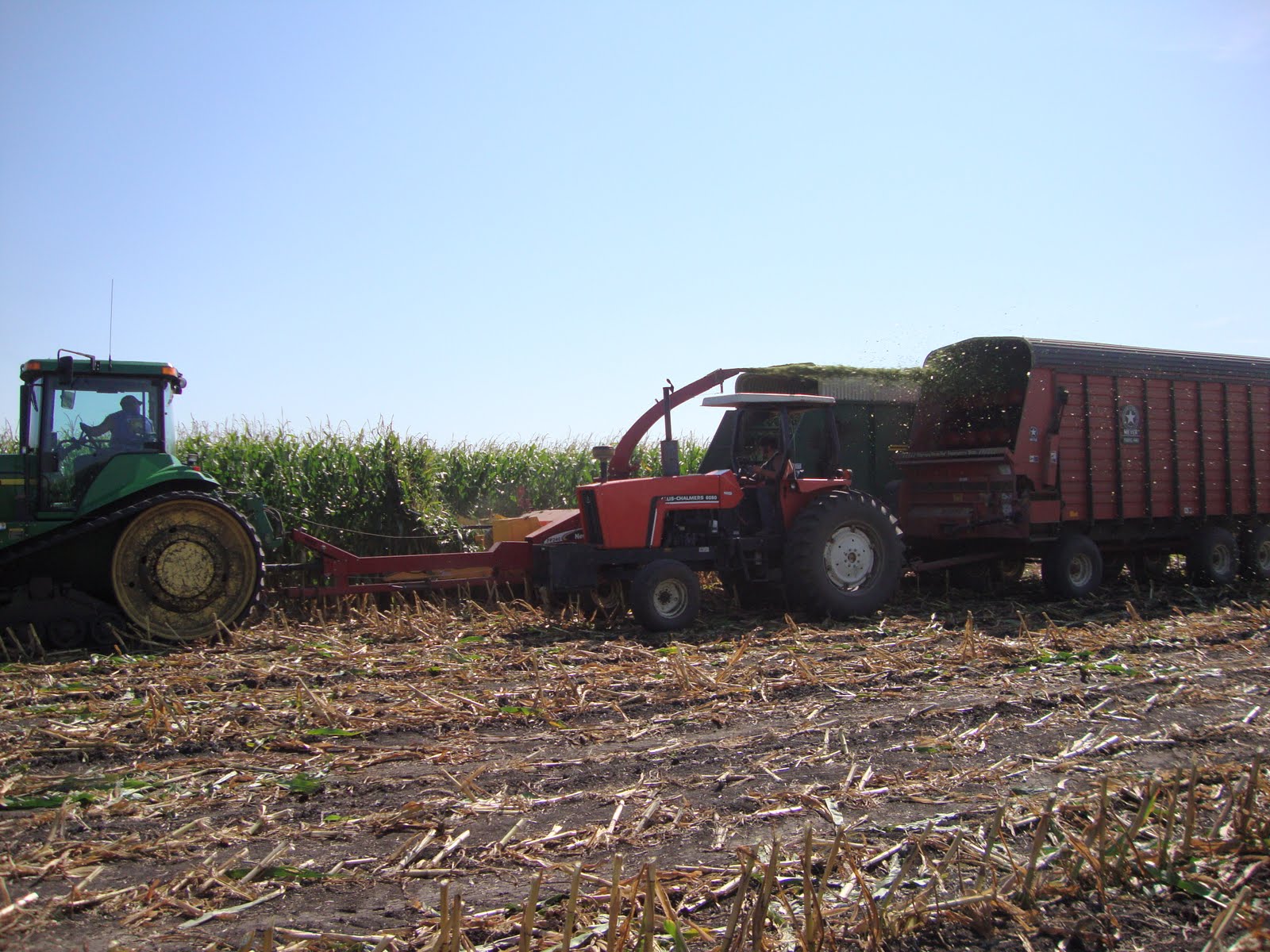
Chopping corn silage in "our" corn field.

Filling the bagger (the machine with packs the corn silage into the long silage bags).

My brother in law and our friend showing off, as they are side winding corn silage into the 2nd silage box so that the chopper doesn't have to stop chopping.

Thanks to the dry and warm weather we had a fair amount of dust on our field roads coming into the farm.

Tall rows of corn, green and full of nutrients for our cows!

Last load of the night!  It was a hard one to get in, thanks to some break downs, but we got it done!

Tuesday, August 17, 2010

Corn Silage Season is coming fast!

Our Silage/Grain Corn Variety on July 26th, 2010...looking great! (I'm about 5'7" for a reference for height).


Our Silage Variety plot, noticeably taller than me!  Some as high as 10 feet!

On July 26th, 2010 Our corn was looking pretty darn nice! This is plant producing 2 ears of corn! It's going to make delicious feed for our hungry cows!

Seems like we were just talking about the beginning of summer, starting hay season and the 4th of July, but it looks as though we have blasted through the county fair, the MN State Fair is only days away, we finished our 4th cutting of alfalfa last week and we are looking at starting corn silage in a matter of days as well!  Where did summer go!?!?!?  Above are some pictures that I took of our stellar looking corn crop.  As you may recall,  Jon and I are growing our first field of corn, to be chopped as silage for our cows.  This 25 acre field will feed our cows for about 3-4 months, so it's not really enough for the year, but it helps to be able to raise our own feed instead of purchasing ALL of it.  In order to make enough corn silage for our cows this year we will need to chop about 120 acres to feed each of our cows, heifers and calves for the coming year.  We will fill about 9 silage bags (250 feet long and 10 foot diameter) as well as 2 upright silos, for about 3000 tons of corn silage. 

We planted 2 different types (varieties) of corn this year.  We planted our "usual" variety which is a conventional (no genetically modified traits) which can be used as a grain corn (tends to be harder and higher in starch) or as a silage corn (plant material, leaves and stalks are more digestible for cows to eat).  We also planted a "test" plot where we are trying out some silage specific varieties that are even more digestible for cows.  These 4 varieties (you might notice the difference in heights in my picture, since they are drastically different) are also GMO (genetically modified organisms) varieties.  We are not sure what to think of these crops yet, as we will need to feed them to the cows and let the cows tell us what they think (it's their opinion that really matters!).  Right now we know that the silage specific varieties are VERY tall and are making some nice ears of corn, however the conventional variety is producing some even NICER ears of corn, some plants with as many as 3 ears/plant!!!  In the end though, we really focus on making excellent feed, that provides energy and fiber for our lovely ladies!  It's what our cows tells us about our feed that really matters....if they don't like it, it does us no good, therefore a HUGE focus on quality is key.  Stay tuned for more info from the fields and if you are interested, check out our Facebook Page for more pictures of corn and alfalfa! and some cows too!

Wednesday, August 11, 2010

Hello Blog, I am back again!

After a little time off to work on various other projects for the upcoming county fair, I thought I would just let everyone know I am still alive and kicking.  It's be crazy at the farm right now.  It's been raining about every 2-4 days and we are trying to make 4th cutting alfalfa in between showers/storms.  Our corn is loving this weather though, as it thrives with heat and moisture.  The cows are hanging in there with the heat.  Milk production has come down about 2-3 pounds per cow and their feed intake is down.  I wouldn't want to eat in this heat either.  Thank goodness for sprinklers and fans, those things have paid for themselves 10 times over already!  I know that the cows will be fine as long as we have sprinklers on them. 

Other than that we have the county fair this week, which means I will be busy with the princesses, the anniversary for the princesses, the dairy show and well....hopefully a demolition derby or two!  Stay tuned for pictures and more stories!

Friday, May 28, 2010

2010 Alfalfa Season-1st Cutting Video

I took some time tonight to do what I wanted to do last night, but instead had to respond to yet another attack on America's good dairy farmers.  Tonight, I finally got to put together my video clips from hay making last week, into a nice "collage" of videos.  Please check out how we at Orange Patch Dairy work to make high quality forage to feed our cows during the year.  The best part is that we get to do this 3-4 more times this growing season....I like this video and I hope you do too!!!

Sunday, April 18, 2010

Manure Management Meetings on Friday

It's been a busy weekend, but I wanted to take some time to recap some of the things that we worked on Friday.  We had a BUNCH of meetings on Monday at the farm with the various professional that we work with to help us make good choices for our land and resources.  This year we are planning to grow our 1st crop of corn!  Previously Jonathan and I purchased all of the feed that we feed our cows from my father in law.  Growing our own crops (at least part of our feed needs) will allow us to save money as we can work to grow feed at a lower cost than we can purchase it...not that my father in law ripped us off, but now we can use our own labor instead of paying him and our own manure instead of giving it away to neighbors. 

We work with our local cooperative's agronomy department, which helps us mange our soils and crops. We pulled soil samples a few weeks ago to determine the quality of the soil in our field.  The good news is that with the management of manure in the previous years resulted in some very fertile soils that will only require a small amount of commercial fertilizer to get the corn started.  The remaining nutrients are already in the soil thanks to cow manure from last fall!  Another excellent bonus is that this lower level of commercial fertilizer will not only reduce the total cost of growing corn but increase the biological activity of the soil microbes (bacteria) which break down cow manure and crop residue (leaves and stalks left over from last year).  We were excited to hear this news and even more excited to get into the fields to get that corn planted!

We also work with a private practice agronomist/manure management specialist.  His name is Al, and he helps us keep track of so many things on our farm regarding manure.  Al has been sampling our manure for the past few years, making sure that we don't over or under apply manure to our soils.  This insures that we will always apply our cow manure at the appropriate rate.  We have even calibrated all of our manure spreaders so we know how many pounds/tons of manure we apply per acre.  One project that we have our friend Al working on right now, is recalculating our manure management plan.  Our manure management plan is a document of many pages which accounts for the amount of manure that our cows produce each year and how many acres that are required in order to apply that manure.  A series of manure samples, soil samples, and calculations are included and used to determine those acres.  As our herd has grown this past winter, we have to re-calcualte the manure management plan, making sure yet again that we do not over apply manure. 

Maintaining our soils is our number one goal.  Manure is not a pollutant when used properly, but instead a GREAT fertilizer which grows some of the best corn in the area!  I even use manure to grow my flowers, fruits and vegetables....and I have an amazing crop each year!

Sunday, March 7, 2010

Warm March Weather

Oh this Sunday was wonderful. Even though it was cloudy, foggy and rainy...the snow is melting and the temperatures are rising.

This morning we were greeted with a cow in labor. #97, who is 6 years old was in the process of calving, we decided that since she started before we found her that she may need some help. We assisted her labor and delivered a beautiful baby heifer calf. We named her Tracy. Within an hour Tracy was up and running around. We quickly milked #97, fed Tracy, and made sure that #97 was eating her morning meal of TMR (total mixed ration). Seems like we only get heifers on Sunday mornings, which make us late for church, but at least we have an excellent excuse.

We got to church, went out to eat at our favorite Mexican restaurant, and returned to the farm to finish feeding the rest of the cows and heifers. Rest assured no animals ran out of feed, since we usually feed extra on Saturdays to make sure that the milking cows, heifers and dry cows have enough feed to let us enjoy church and a nice "day date". After swiftly feeding the animals, we went home and enjoyed a lovely walk outside. Though brisk, the 35 degree temperatures feel like a tropical paradise compared to a few short weeks ago when it was 35 below zero instead.

This weather is giving me the "itch" to play in the dirt. I am eagerly looking forward to planting my garden and planting our first field of corn. Spring-like weather also gives me the energy to tackle last minute projects at home, before I would rather spend my time outside in the garden. I managed to fully clean the kitchen this weekend and living room. I don't know how much more I will accomplish since we have a busy week scheduled on the farm, but we will see, with this new energy I may still find time. And I am so thankful to have my computer back!

Tuesday, February 9, 2010

Why do you take the calves from their mothers?

I had a comment on one of my earlier posts where a concerned vegan had an issue with dairy farmers removing calves from their mothers. I thought about this practice and how misunderstood it actually is. So, since we had a brand new baby heifer calf born Sunday morning (which made us late for church-it was a good excuse) I thought it was a perfect example of this practice.

#663, otherwise known as Ruth Anne gave birth early Sunday morning (at about 5 am, when we weren't at the farm) to a little heifer calf, who is #814 in our records, but Ruthie to me. When we arrived at the farm for morning chores, I headed immediately to the dry cow pen, where I found Ruthie running around the pen and Ruth Anne keeping a watchful eye on her. Ruthie was making friends with the other dry cows, and needed to be moved. Healthy calves are able to stand and run at an hour old! Ruthie was loaded up in the wheel barrow and brought inside the calf barn, or nursery. Here Ruthie received an oral vaccination for scours, her navel was clipped and dipped with iodine. All 3 of these steps are done to assure that each calf born has a good start. Ruthie was placed in a freshly bedding stall, where she could be clean and free of pathogens. Just like babies born at a hospital and placed in a nursery. After making sure Ruthie was nested in, we headed outside to walk Ruth Anne to the milking barn. We walk our cows, it's the simplest way and the calmest method to move cows. Ruth Anne is a 2nd lactation cow, so she knew where she was headed. We ran Ruth Anne into the parlor and milked her. Ruth Anne then headed out to our fresh cow pen where she had free choice fresh warm water and all the nutritionally formulated feed she could eat.

Here Ruth Anne gets time to focus on taking care of herself, instead of worrying about her calf. Fresh cows require a lot of special attention. In the barn we check a variety of things every morning for ALL fresh cows, for their first 20 days. We check their temperatures (checking for infections), their rumen fill (how full their stomachs are), their ketosis level (liver health), and their bright eyes (overall health). If any of these items are off, we immediately work further to treat our cows, most of the time without antibiotics, but with probiotics. But enough about cows....back to Ruthie....

After milking Ruth Anne, we haul a pail of fresh colostrum (mother's first milk) back to the calf barn. We only feed colostrum from animals that we know are healthy and free of disease, if the mother is not free of disease we have frozen colostrum from healthy cows available to feed. Ruthie got fed over a gallon of colostrum, within hours of birth. In nature this is not always the case. Calves struggle to find their mother's milk and may not get the right amount, right quality or a timely feeding. Colostrum fed early in life increases passive immunity. Mothers pass immunity onto their calves through colostrum, but the calf is best able to receive this immunity during the early hours of life versus the later hours of life. Within 24 hours, on our farm, a calf will drink about 1.5-2 gallons of colostrum.

Another issue with letting calves suckle their mothers is an increased chance of infection in the calf and the cow. The calf can receive pathogens from the teats on the cow, since the teats are not properly cleaned. The cow can receive pathogens from the calf's mouth since it is also not clean. By using clean and sanitized equipment to collect colostrum and a clean and sanitized bottle to feed the calf we prevent pathogens from transferring, but still get the advantages of passive transfer immunity.

Other possible issues with leaving the calf with the cow are abandonment and injury. Sometimes there are mothers that are not good mothers. It doesn't come naturally. First calf heifers are some of the best examples of this. Once they deliver a calf, they may walk away, never lick off the calf and move to the feed bunk. The calf would be left to die, cold and wet. Sometimes cows, especially other cows, can hit or push around the newborn calf. They can even step on the calf. I have seen this happen, just after birth a fresh cow got up and swung around and stepped on her calf's leg. Luckily the calf wasn't injured badly.

Farmers care for their calves and fresh cows. Calves are the future of our herds-we want them to have an excellent start in life and cows are our present, and we want them to also have an excellent start. Removing calves from cows is not cruel, its actually in the best interest of both animals, both receive the best care possible. Because our cows always come first!

Friday, December 11, 2009

It's beginning to look a lot like Christmas!

The radio is blaring Christmas tunes, and the weather is agreeing with the season-we have snow, we have cold, and we have blowing. It's been hard to deal with this winter weather though, because it is so extreme. We have been dealing with temperatures much below zero, wind chills much below zero, winds over 30 mph, and 6 inches of snow. This weather has cause a few problems and challenges. With cold weather we have do to some extra things each day to continue to take good care of our cows.

Challenges:
  • Frozen pipes: Those pipes, with the right amount of wind will ALWAYS freeze! Water is a critical nutrient for cows and calves so we HAVE to thaw the pipes everyday, sometimes twice a day.
  • Snow removal: snow blows everywhere and gets into everything. We must push snow, shovel snow, and blow snow in order to just get into the barn to feed and milk the cows.
  • Moving: yes moving is so much harder now, with 4 plus layers of clothes on it get to be pretty cumbersome to walk around.
  • Starting Tractors: yeah, tractors really don't like to start in the winter-it's too cold and their fuel systems like to "gel" up.
  • Frozen manure: hot, fresh cow pies will freeze in an instant on the right day. Manure is so much harder to move when it is frozen-making clean up so much more difficult.

Extra Cold Weather Tasks:

  • Feeding the cows extra feed: cows need extra calories to stay warm during the winter months, just like we do. Long winter hair helps to keep cows warm, but heating from the inside out works for cows just like hot soup in people =)
  • Bedding the cows extra: Cows need extra bedding to stay dry and warm. Cows and calves like to "nest" in their bedding in the winter. Therefore we need to make sure that we supply LOTS of straw for everyone.
  • Feeding the calves extra milk: Calves need extra milk as well for extra calories, so even get a calf "jacket" or "blanket" to stay warm on those cold winter nights.
  • Baby Calf Watch: We have to keep an extra eye on the dry cows due soon to have their babies. Winter is not a great time to have a calf. Typically we would be enjoying temps about 25 right now, but thanks to this artic chill we have about 12 cows yet to calve before Christmas and they are all at risk for frost bite. We check on each of them at least 6 times each day, so that the moment that they start labor we can move them to a warm pen indoors to have their calf safely-we always do the best that we can for our cows and calves so a good start is critical!

Wednesday, August 19, 2009

Sleep needed!

Just thought I would let you know I am still alive, just that sleep is needed. After surviving the county fair with about 5 hours of sleep a night, we moved right into 4th cutting of alfalfa hay. Yesterday (Monday) we started cutting our 100 acres of hay, and today we finished cutting and chopped it all. 100 acres of 4th cutting hay should have filled at least 7/8 of a silage bag, but since we have been SO DRY it only filled about 1/3 of a bag. This means we will have to make more corn silage for the cows in order to have enough feed to feed the cows this winter. Corn silage will be starting in a few short weeks, so we will have to do some planning before then. Our alfalfa was beautiful, but so dry....so we hope for rain for a better 5th cutting of alfalfa in September. I will add more info from the fair hopefully tomorrow ;)

Thursday, May 14, 2009

Pictures from the Preschool Tour!

I finally got some time to sit down and post some pictures. The preschool tour threw off our schedule at the farm just a little, and now we are working on planning the tour for the High School Ag class coming next Wednesday. I love pictures of kids seeing a dairy farm for the first time...and a picture is worth a million words. Also a HUGE thanks to the Dairy Princesses that came out to spend time with the kids on Monday! I know they had a blast seeing a real life princess in person!
Explaining to the kids that in the summer heat we run sprinklers, which are ALOT like water parks....so fun for cows too!
Kids enjoying snack time, cheese and crackers.


Dairy Princess Angie handing out stickers to the preschoolers-which say "I met a dairy farmer".-Those were awesome stickers!!!

Meeting Baby Joey. Those kids wanted to hug Joey so badly!

Talking about what we feed the cows to the little boys, so curious about the smells that they smelled.

Petting a cow for the first time. They weren't scared at all!

Snack time with cheese and crackers, and their new stickers.

Mmmmm...juice boxes :)

The best group picture we got at the farm!

Mainly, as you can see, 21 preschoolers and a baby calf are all hard to manage and get to stand still, oh well.

Bottle feeding calves with Dairy Princess Val. Kids LOVED this activity!

Bottle feeding with Dairy Princess Angie. Odessa enjoyed all of the extra attention.

HAY RIDE! The boys were huge fans of the hay ride, but we learned that only boys should drive not girls, like me ;)

Loading the hay ride to the calf barn.