Showing posts with label corn silage. Show all posts

Wednesday, September 9, 2015

Family Farming at its Best!


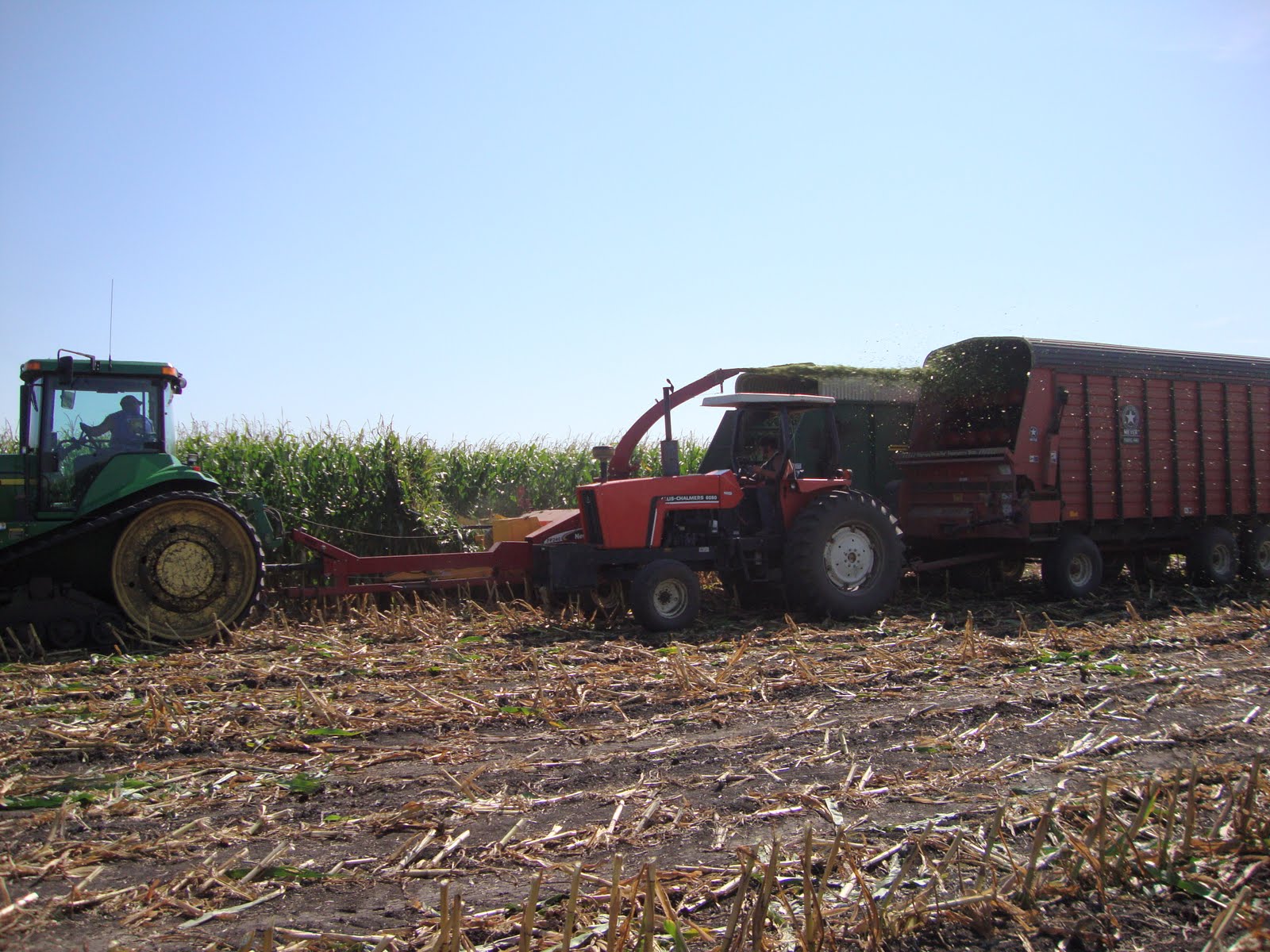
As I get older I find myself stopping and reflecting on the many blessings in my life.  Over the Labor Day weekend I had the great opportunity of working on my family’s farm, helping to harvest corn silage. While I was waiting for loads to haul I couldn’t help but smile and thank God for how blessed we are to have our family and our family farm.  We were able to keep moving with the help of a good family friend who helped us for 2 days when he could’ve been relaxing with his friends.  This weekend both of my younger sisters were home helping do chores, feed calves, milk cows and delivering new calves (we had 3 new calves this weekend!).  My mom was busy with her job in town but still made time to cook meals for us and bake us treats.  My sister in law did the same, making us a delicious meal for supper one night and bringing my niece out to the field to watch her daddy chopping corn.  I love my niece, watching her farm girl personality just get ignited by the activities in the field was amazing.  The girl really loves her farm implements.  My 93 year old grandfather drove out into the field on Labor Day.  Watching him smile with pride and joy as his son and grandson farm the very land he and his father farmed together, well frankly that expression on his face was priceless.  I will always remember Grandpa's smile and his wave as I cruised past him.  I will also remember how proud my dad was to make his dad proud, dad was grinning from ear to ear.   Very few professions are linked with this type of legacy and the connection to the generations past, present and future.  It was so great to see everyone working as a team to accomplish the goals of the day. 


Putting silage into long bags for storage for the year.

I love helping at the farm! Watch me haul silage home!
Another great blessing for the day was the beauty of watching the growing crops being harvested for food and feed for the growing dairy cow herd.  Corn silage is the main ingredient in cow diets.  Not to be confused with corn grain, corn silage is the complete plant (stem/stalk, leaves, and corn grain/cob) chopped up into small bite sized pieces for cows.  My brother and dad did an excellent job to get the corn harvested at the correct moisture, and then set the chopper for the correct cut length.  The result is a feed that smells amazing and will help supply very important nutrients for the cows.  Working with nature is such a blessing: planting seeds and watching them grow through the heat, rain, wind, and storms; reaching full maturity to be harvested for nutrition for cows, which produce milk, a nutritious food for humans; it’s a beautiful cycle. 

During our harvest my brother has been an amazing farmer.  He made sure to take breaks for church and rest on Sunday.  He has been planning ahead to have everything ready for the people helping him.  He also made sure that everyone is well fed and caffeinated. Even through breakdown my brother kept his cool, fixed the broken parts and we kept on moving.  It’s been fun watching my brother grow into a really great farmer, and I am very proud of him.  Family and farming is what it is all about and I am so blessed to have been and still be a part of such a great profession!  97% of all farms are family owned and operated just like ours!

Friday, August 17, 2012

Drought 2012: How it's affecting US Dairy Farmers

I'm hoping to share a more personal reflection of the Drought of 2012 on this blog in the coming weeks, but for now I have a great resource for you to check out!  Please check out www.dairygood.org for their latest article featuring perspectives from some great dairy farmers across the US.  The article Dairy Farmers Endure highlights a lot of the very same issues that we're facing on our own dairy farm.  Rising feed costs, the risk of not having enough forages on hand, and the stress of financial issues are all hot topics on our farm.  So, please take some time to read this great article!

Thursday, April 7, 2011

With high feed costs, we are Planning Ahead....

Well April is here! The weather has really improved in the past few days!  We are enjoying more moderate temperatures and sunshine!  Needless to say, we are working overtime on projects and getting a lot accomplished, but today was for planning ahead.  Often times on a dairy farm, we need to plan ahead, schedule tasks, and make sure that we are using our time and resources to their fullest potential for our cows.  Our dairy consultant/nutritionist Jeremy stopped in for his monthly visit and a planning meeting.

When Jeremy visits, he first walks through the groups of cows and makes observations.  He evaluates how fat or thin our cows are, he watches them eat, he watches them pass manure (and checks that too), he checks our feed, and collects data about the milk we produce.  All of this information helps him to make decisions about what to feed our cows and how much.  Good nutrition is so important to our cows, so we depend on Jeremy's expertise everyday.  Today's report was good: cows are chewing their cuds well, they are passing excellent manure and they are all in great condition (amount of weight they carry-we don't want them too fat or thin).  After talking about the good news we got down to business.

With the recent increases in the corn price, our feed costs are out of control.  The milk price is slowly keeping pace, but it will be hard to make a living milking cows in the next couple months.  Knowing this we needed to develop a plan for our 2011 growing season.  We will be planting our crops in the coming weeks, much of which will be harvested as alfalfa haylage or corn silage for our cows (forages).  After going through all of our options to keep our costs low, while making sure we keep our cows healthy and productive, we decided that we will need to chop more corn silage for 2011.  It is currently more economical to feed corn silage rather than dry corn to our cows, plus cows prefer forages anyways!  We will still feed dry corn (cows need some dry corn too!), but at least we can cut the amount.  We will need to continue to focus on making the best possible feed for our cows this summer, and pray for good growing conditions.  We have a plan, to keep costs low while producing a great product (milk) from healthy cows.  So as we start planting in the coming weeks, we will stick with the plan...stay tuned!

Sunday, January 16, 2011

Update: Cows are back on track!

It's been a little bit since I blogged about our cows and how they have been doing, so I thought I would take this chance to post an update.  Well as you read in CSI: Dairy Farm Investigation, we had a little bump in the road.  After that post we had all of our forages tested.  We test our silage, haylage, hay and straw about once a month to make sure that we know exactly how much protein, energy, minerals, and vitamins are in each.  We build our diets around those forages, and supplement with grains to fill out the rest of our cows' nutrient needs.  The tests came back in a couple of days and we learned that not only had our corn silage increased in energy, but our haylage was more digestible, and our alfalfa hay had more protein in it.  All 3 factors caused our cows to get upset stomachs.  Too many treats for them, and their diet was out of balance.  So we fine tuned the diet once again, and after about 2 weeks on the new diets, we can say the the cows are back on track!  They haven't gained back all of the milk they once had, but that's ok with us, their health is far more important!  It's great to walk into the barn in the morning and see them all chewing their cuds so diligently! (we know we made the right choices then!)

Other than working with the new feed changes, we have also been busy welcoming a number of new calves to the farm.  Be sure to stop by our Facebook Page to see new pictures of our new baby calves!  The mother cows are doing great, and the baby calves are thriving.  I checked the calving list tonight, and we have 14 more to be born this month, including 2 sets of possible twins!!  I can't wait to meet them all!

Minnesota's Winter Weather has also been a challenge for us.  We have been constantly bedding in our cows....to keep them warm and insulated from the cold.  We have also been working move and remove as much snow as we can, since it snows here almost twice a week.   Needless to say, we are experiencing a traditional Minnesota Winter, and all the joys it brings with.  The forecast for the coming week doesn't sound too much more promising, but we can look forward to March....and thawing! 

Monday, January 3, 2011

CSI: Dairy Farm Investigation

Well, besides Christmas and New Year's interrupting my blogging time, Jon and I have been spending a great deal of time at the farm.  We really had a real life episode of CSI: Dairy Farm Investigation, on our farm this week.  As always, we put our cows' health first.  Healthy cows are Happy & Producing cows, but this past week the cows weren't happy.  So....here's what happened:

Monday: We noticed 1 of our heifers (13 months old) was avoiding the feed bunk.  This is odd behavior from a heifer, usually they can't get enough feed.  Jon and I immediately thought she had pneumonia, so we brought her inside for a thorough check up.  Much to our surprise we found that she had a LDA (Left-sided Displaced Abomasum).  Something had cause our heifer Snowflakes to go off feed, get a gas build up in her stomach, which forced her stomach to move from its normal position.  When an LDA happens, it has to be fixed immediately and their are 2 methods to fix it.  The first option is a surgery, where a cut is made in the side of the cow, the stomach is deflated of the gases, and the stomach is sutured to the body wall, preventing it from floating out of position again.  The second option is less invasive, but not always successful.  It involves sedating the animal, rolling her onto her back to force the stomach to the correct position and placing a suture on the bottom of the animal to hold the stomach in place.  We opted for the 2nd option, since it was be less tramatic for our Snowflakes, and since she was a small animal, it would be successful (and it was! Snowflakes is doing great now!).  So once we fix Snowflakes, we started our investigation....something caused her to go off feed and get a LDA...so what was it????  We didn't want any more sick animals, but we were in store for more.

Tuesday: We noticed new fresh cows (cows that just had calves in the past week) were starting to struggle with their feed intakes.  We watch our cows diligently, and because of that we noticed almost immediately that they were not eating enough feed.  We worked to treat them with probiotics, vitamins, and minerals to help appetite, but it wasn't working.  Our investigation continues....

Wednesday:  We found another LDA animal...a mid-lactation (cow that has been milking for more than 100 days) which had suddenly floated a LDA!  Luckily our vet came to our rescue, and we did surgery (with large milking cows we always do surgeries for LDA's to guarantee success).  Our cow Ozzy, for no apparent reason also went off feed, filled her stomach with gas, and floated it out of position....now we were really concerned....LDA's in cows don't happen at that stage of lactation.  We thought it could be our new alfalfa haylage that we started on Christmas, or maybe our new alfalfa hay that we had delivered on Christmas.  So, we tested both feeds and kept on investigating.

Thursday:  We noticed the cows were producing almost 5 pounds less milk per cow each day...this was a dramatic change!  What seemed like a good day, was about to be a storm of problems brewing for Friday.....

Friday:  3 more cows floated LDA's!  3 more surgeries!  2 were mid-lactation cows and 1 fresh heifer!  Now we were really worried!  Did we have an epidemic on our hands?  What was making our cows sick?  How can we stop this?  We started to brain storm, and after some thinking we put the pieces together and contacted our nutritionist with Cargill Animal Nutrition.  After talking with Jeremy, we confirmed our suspicions.  So....what was making our cows and heifers sick???? ........Our Corn Silage!

Diagnosis:  Corn silage is a lot like wine...as it ferments, the longer it stays sealed the better it becomes.  Corn silage fermentation helps to make the fiber more digestible, but as it becomes more digestible, the cow's rations need to be adjusted to ensure that the cows are eating enough fiber each day.  If a cow doesn't get enough fiber in the ration, she gets loose manure, she has a reduced appetitie, she chews her cud less, and can even float a LDA!  So our corn silage has been working hard these past few weeks to become better and better, but the cows weren't giving us the signals we needed to see to make the changes to avoid upset stomachs and LDA's.  I would relate this to when we eat too many Christmas sweets...we have a stomach ache, and so do they!

Sollution:  The sollution was easy!  We needed to add more fiber!  So we are now feed more total forage to our cows.  The extra forage comes in the form of extra alfalfa haylage and corn silage.  But we also added straw to our ration.  Our cows are now eating 100 pounds of feed each day, that also serves them 1 pound of wheat straw.  The straw helps to slow the rate at which feed goes through the stomach, but it also encourages the cows to chew their cuds more.  Cud chewing is great for cow health~!  So after making these changes already on Friday, we know we are back on track!  It's so scary to see your cows getting sick and not know what is making them sick, but it is always rewarding to figure out the cause and return them to good health once again.  As always, our cows health always comes first!!

Friday, November 12, 2010

Wish my Camera had Smell-O-Vision!

Today we opened our first bag of 2010 corn silage for our cows' lunches.  We were filled with anticipation this morning as we speculated what we might find in that silage bag.  As you may recall we made 8.35 bags of corn silage this past August.  We worked so hard to get the corn chopped at the right moisture, with the right level of starch in the corn, and chopped at the correct length (check out our video to refresh your memory!).  All of these factors help to make corn silage an amazing food source for cows.  Not only is corn silage a great source of energy (corn starch) but it also an excellent source of fiber (plant leaves and stalk) for our girls.  We feed roughly 50 pounds of corn silage per milk cow each day, making it the primary food of our cows.  When we chopped our corn this past August, it looked like the picture below.  The plants were green & the corn was bright yellow. 
 We sealed it inside the plastic silage bags like a ZipLock bag, with a coating of inoculant (good bacteria used to help preserve the silage). When we seal the bags we never know for sure what we will find when we open them. Every year it is a surprise. We hope that we did our jobs right; that we did the best that we could and would have an amazing feed for our cows. Each year we strive to do better than the year previous. This year we planted a variety of corn that was expected to be higher in digestible fiber for cows, therefore also higher in energy (cows also derive energy from fiber digestion!). So when the big moment came and we opened the seal on our silage bag...this is what we found!!!!
Yep! I sure wish my camera had Smell-O-Vision!  This corn silage smelled great!  It has a sour aroma to it, but with hints of a sweet flavor.  The sour is the vinegar that is produced during fermentation in a silage bag and the sweet is the beloved lactic acid, which makes silage awesome.  It's odd that we look forward to our silage, but our cows' health and well being depend on our ability to make good feed.  This silage was so tasty for our cows, that they ate more than we expected today and we will have to increase the amount fed to them tomorrow!  Hopefully this will result in more milk production as well as continued good health for our cows!

Friday, September 17, 2010

We're not Lucky, we're Blessed!

Well, we wrapped up our 5th cutting of alfalfa this week, so as a result I have been working on that and recovering from the end of forage season marathon. It's been crazy, so a couple of days this week, we did the necessary chores and then came home for a nap (a much needed nap). The last load of alfalfa haylage was loaded into the silage bagger on Tuesday night at 7pm, and we celebrated with a good 'ol local beer (Grain Belt Premium Light)! It was a tasty beer! After working so hard this summer to make excellent, delicious, wholesome food for our cows, we figured we deserved the treat for ourselves. As we reflected on the past few months, we started to call ourselves "lucky", but I stopped short of calling us lucky. "We weren't lucky, we were blessed," I exclaimed. Jon looked at me, "I suppose we were."
As farmers, so much of what we do depends on nature. And nature is unpredictable, unmanageable, and uncontrollable. It's our faith in God that helps us pull through the though moments in life and on the farm. God protected us from storms, hail, wind, floods and droughts. God helped us work safely this summer, so that we were able to make tons and tons of feed, while the friends and family that helped us were kept safe. God helped us dodge some untimely rains, but also received some timely rains. Our first crop of corn yielded greatly, a miracle in our eyes. God protected our alfalfa from bugs and pests the entire summer, allowing us to grow alfalfa without spraying it with pesticides (saving costs and making better quality feed without insect damage).

So many times during a growing season, the crop can be destroyed, but we know we were blessed. Our former priest told us once that farmers are some of the closest people to God. "Farmers have to be close to God, to battle nature, feed the world's hungry, and work countless hours without recognition, while providing for their families." Those words have always stuck with me. Watching my grandparents and parents (who also farmed) I know that our priest was correct; they all have great relationships with God.

So, as the forage season of 2010 ends (we have some combining to do yet, but most of our crops are harvested) we THANK GOD for all of the blessings and miracles that we have received, for we are not lucky, we are blessed!!!!

Wednesday, September 1, 2010

Corn Silage 2010

Well I know it's been a long time since I blogged, but I am hoping now that a majority of our forage harvesting for the year I will have more time to devote to this blog.  Since we were busy chopping corn silage last week, taking about 4.5 days to chop over 2800 tons of corn silage for our cows from about 135 acres of corn, I thought I would do a short/long/informative recap of the week's events.

A little information about corn silage first though.  We strive to feed our cows a high forage diet (a diet composed mainly of fiber/forage instead of grain, which promotes excellent rumen & cow health).  The vast majority of our diet's forage comes from corn silage.  We like corn silage because it not only provides valuable fiber material for our cows but also highly available energy in the form of corn grain.  The corn grain in corn silage has been processed (crushed so that rumen bacteria can digest the corn starch to make proteins to feed the cow) and the corn is also wet-also making it more digestible.  Our cows eat over 100 pounds of feed each day, and over 50 pounds of that is corn silage.  As such a large portion of our cows' daily diets, corn silage quality becomes very critical. 

Excellent cow health on our farm starts with excellent nutrition.  We harvest our corn at 65-69% moisture.  A normal corn plant is about 75% moisture, but after the corn grain is mature, with the onset of fall, corn plants begin to dry down and lose moisture.  With the warm temperatures this summer and excellent growing conditions, we had an earlier than expected harvest of silage.  We also had to work faster than expected to beat the weather.  With temperatures in the 90's and strong southerly winds, the clock was ticking.  Usually corn will lose about .5% of moisture each day in normal temperatures, but with the increased temperatures we were losing more moisture than expected.  We pushed even harder to finish the harvest, and thanks to an awesome friend of the family (who donated his time and his tractor) and an awesome brother in law...we were able to reach our goals.  On Sunday night/Monday morning we ran the last load of corn silage into the bag, celebrated with a beer and "hit the hay".  Monday we sealed silage bags, and boy did they smell amazing!  I LOVE the smell of freshly fermenting corn silage.  It's comforting to know we have most of our feed for our cows for the upcoming year in bags.   We have been truly blessed!  Please feel free to check out the pictures below from the week's events as well as a new video I added to YouTube.


Rows of delicious feed for our cows this coming year.

Chopping corn silage in "our" corn field.

Filling the bagger (the machine with packs the corn silage into the long silage bags).

My brother in law and our friend showing off, as they are side winding corn silage into the 2nd silage box so that the chopper doesn't have to stop chopping.

Thanks to the dry and warm weather we had a fair amount of dust on our field roads coming into the farm.

Tall rows of corn, green and full of nutrients for our cows!

Last load of the night!  It was a hard one to get in, thanks to some break downs, but we got it done!

Tuesday, August 24, 2010

Corn Silage is Ready!

Today we check our corn to determine if it is ready to be chopped for silage....and it's ready!!!!  How do we know that it's ready?  Well, I drove out into the field this afternoon and collected samples of corn stalks.  In each field I chose 10 stalks of corn and chopped them with the chopper.  We collected a sample of the chopped corn, measured it, and dried it with a Koster tester (which removes water from a sample with the use of heated air).   After re-measuring the sample we can determine the moisture of the total corn plant.  It is ideal to chop corn silage at about 65-69% moisture to be packed into the silage bags.  Today's samples told us that the corn is about 64-70% moisture, so it is time to start chopping!!!  BUT....we are not ready to chop. 

Last September, we basically destroyed the processor on our chopper.  The processor is part of the chopper which crushes corn grain and corn cobs into smaller pieces which are more digestible for cows.  By processing our corn we are also able to cut the leaves and stalks into larger pieces which encourages improved rumen health for our cows.  This processor is a critical part of our corn silage chopper...and we haven't fixed it since it broke.  Today we hit the ground running, making sure that we get the chopper fixed!  Jon and his brother Marcus worked long into the evening tonight, putting on the new processor.  They are not done yet, but it did rain tonight which buys us about 1 day of additional time to get it ready to rock.  We have 9 bags of silage to make this year (each about 250 feet long and 10 feet around).  It will be a long task, but with some help from neighbors and family we will get it done as quickly as possible...so the marathon begins!!!  Corn silage season is here!!!!

Tuesday, August 17, 2010

Corn Silage Season is coming fast!

Our Silage/Grain Corn Variety on July 26th, 2010...looking great! (I'm about 5'7" for a reference for height).


Our Silage Variety plot, noticeably taller than me!  Some as high as 10 feet!

On July 26th, 2010 Our corn was looking pretty darn nice! This is plant producing 2 ears of corn! It's going to make delicious feed for our hungry cows!

Seems like we were just talking about the beginning of summer, starting hay season and the 4th of July, but it looks as though we have blasted through the county fair, the MN State Fair is only days away, we finished our 4th cutting of alfalfa last week and we are looking at starting corn silage in a matter of days as well!  Where did summer go!?!?!?  Above are some pictures that I took of our stellar looking corn crop.  As you may recall,  Jon and I are growing our first field of corn, to be chopped as silage for our cows.  This 25 acre field will feed our cows for about 3-4 months, so it's not really enough for the year, but it helps to be able to raise our own feed instead of purchasing ALL of it.  In order to make enough corn silage for our cows this year we will need to chop about 120 acres to feed each of our cows, heifers and calves for the coming year.  We will fill about 9 silage bags (250 feet long and 10 foot diameter) as well as 2 upright silos, for about 3000 tons of corn silage. 

We planted 2 different types (varieties) of corn this year.  We planted our "usual" variety which is a conventional (no genetically modified traits) which can be used as a grain corn (tends to be harder and higher in starch) or as a silage corn (plant material, leaves and stalks are more digestible for cows to eat).  We also planted a "test" plot where we are trying out some silage specific varieties that are even more digestible for cows.  These 4 varieties (you might notice the difference in heights in my picture, since they are drastically different) are also GMO (genetically modified organisms) varieties.  We are not sure what to think of these crops yet, as we will need to feed them to the cows and let the cows tell us what they think (it's their opinion that really matters!).  Right now we know that the silage specific varieties are VERY tall and are making some nice ears of corn, however the conventional variety is producing some even NICER ears of corn, some plants with as many as 3 ears/plant!!!  In the end though, we really focus on making excellent feed, that provides energy and fiber for our lovely ladies!  It's what our cows tells us about our feed that really matters....if they don't like it, it does us no good, therefore a HUGE focus on quality is key.  Stay tuned for more info from the fields and if you are interested, check out our Facebook Page for more pictures of corn and alfalfa! and some cows too!

Sunday, April 18, 2010

Manure Management Meetings on Friday

It's been a busy weekend, but I wanted to take some time to recap some of the things that we worked on Friday.  We had a BUNCH of meetings on Monday at the farm with the various professional that we work with to help us make good choices for our land and resources.  This year we are planning to grow our 1st crop of corn!  Previously Jonathan and I purchased all of the feed that we feed our cows from my father in law.  Growing our own crops (at least part of our feed needs) will allow us to save money as we can work to grow feed at a lower cost than we can purchase it...not that my father in law ripped us off, but now we can use our own labor instead of paying him and our own manure instead of giving it away to neighbors. 

We work with our local cooperative's agronomy department, which helps us mange our soils and crops. We pulled soil samples a few weeks ago to determine the quality of the soil in our field.  The good news is that with the management of manure in the previous years resulted in some very fertile soils that will only require a small amount of commercial fertilizer to get the corn started.  The remaining nutrients are already in the soil thanks to cow manure from last fall!  Another excellent bonus is that this lower level of commercial fertilizer will not only reduce the total cost of growing corn but increase the biological activity of the soil microbes (bacteria) which break down cow manure and crop residue (leaves and stalks left over from last year).  We were excited to hear this news and even more excited to get into the fields to get that corn planted!

We also work with a private practice agronomist/manure management specialist.  His name is Al, and he helps us keep track of so many things on our farm regarding manure.  Al has been sampling our manure for the past few years, making sure that we don't over or under apply manure to our soils.  This insures that we will always apply our cow manure at the appropriate rate.  We have even calibrated all of our manure spreaders so we know how many pounds/tons of manure we apply per acre.  One project that we have our friend Al working on right now, is recalculating our manure management plan.  Our manure management plan is a document of many pages which accounts for the amount of manure that our cows produce each year and how many acres that are required in order to apply that manure.  A series of manure samples, soil samples, and calculations are included and used to determine those acres.  As our herd has grown this past winter, we have to re-calcualte the manure management plan, making sure yet again that we do not over apply manure. 

Maintaining our soils is our number one goal.  Manure is not a pollutant when used properly, but instead a GREAT fertilizer which grows some of the best corn in the area!  I even use manure to grow my flowers, fruits and vegetables....and I have an amazing crop each year!

Saturday, September 26, 2009

Corn Silage Season Part 2


A little night time action at the farm. This video was taken on September 7th, 2009 (Day 1). We finished opening the fields and wanted to get a head start on the long and hectic week ahead. The key to making good silage is to make it quickly as possible at a consistent moisture. Consistent moisture helps to make quality forage which feeds our cows who make safe, wholesome, nutritious milk for you the consumer =) Please enjoy our little video of night time silage chopping at Orange Patch Dairy!

Friday, September 25, 2009

Corn Silage Video Part Posted!

Finally I got at least the first video posted from corn silage season! We started chopping on September 7th, 2009 and finished on Monday September 14th, 2009. We worked 6 days and made 8, 250 foot long bags of forage.....equal to about 2500 tons of silage for the cows for the coming year!!! Once the forage is made we store it in bags for at least 3 months to make sure the feed is completely fermented. This video is from the 7th, when the neighbor came over to "open" our fields. He drove his self propelled chopper (a forage chopper that has an engine attached to it instead of chopped like ours which needs a tractor to pull it) through our fields chopping end rows and making "roads" through to make sure that we do not run our precious crop of corn down. Check it out!

Saturday, September 12, 2009

Rain delay AGAIN!

Oh Dear! Apparently God would like us to take the weekend off to attend a family wedding instead of finishing corn silage. Today we received almost an inch of rain today---much needed for the alfalfa that we just planted but as of today we only have 6 of 8 bags of silage finished. We were hoping to make headway yesterday but found that we had a broken shaft and pulley on our silage chopper, so we had to stop, order parts and wait for them to arrive this morning. We replaced the broken parts and started chopping at noon, only to be rained out of the field again. We need to make 2 more bags of silage, but they will have to wait until Monday, when the fields will finally be dry enough to go back in with our heavy equipment.

So instead of finishing chopping, we will be taking the weekend off to go to a cousin's wedding near Rochester MN. We are super excited to see family that we haven't seen in months! We are also excited to sleep in...since we will be spending the night, and we have some great friends hired to milk while we are away. We only hope that everything goes well for those whom we leave behind with our cows....I had a speech with the girls to make sure that they don't cause any trouble for us =) See ya on Monday!

Wednesday, September 9, 2009

Rain delay...

Darn rain shower...poured .3 of an inch on us tonight, just as we were starting to really get going on chopping for the day. We have 3.75 bags of sialge done and we need a total of 8 bags of silage....so we have a LOT of work to do in a short period of time. We need to make 2 bags of silage each day for the next 2 days so we can go to a wedding this weekend. God willing we will get it done...so we pray.....the corn is too wet to chop so we must wait for it to dry. Hopefully tomorrow we can start early to make up for this RAIN DELAY.

Monday, September 7, 2009

Labor Day Celebrations!

As you venture off to your Labor Day celebrations tomorrow, we at Orange Patch Dairy will begin the process we know and love as "Corn Silage Season". Yes, it is time, the corn is dried down enough to be chopped, hauled home, and packed into large 250 foot plastic bags. These bags will store enough feed for all of our cows, heifers, and calves for the coming year. Corn silage is the primary feed in our cow rations, as it makes up about 35% of the total diet (50 pounds per cow each day). We will be making about 2200-2400 ton of corn silage this year, and we hope to finish it by the weekend (5 days start to finish). Therefore I might not be blogging in the coming days but I hope to be gathering some great pictures and video from the farm to show and tell about silage season. But I do have some thoughts on Labor Day I wanted to share....

Dairy farming is a hard labor filled job, but ask any dairy farmer and they would tell you how much they love their jobs. It's a dairy farmer's passion and drive for what they do that helps them through tough years like this year. It is their love of their job, cows, and nature that helps to get them through each day and forces them to wake up each morning only to repeat it over again. Right now we aren't getting paid to milk cows, but in fact we are paying an admission fee to go to work each day. How would you feel if your boss was standing at the door each morning collecting a fee to enter and do your job? It wouldn't feel too good, but for a dairy farmer, there are so many other "gifts" of the job to make it worth while. I wake up each morning looking forward to the next baby calf, the next gain in milk production, a pretty sunrise, fresh cut hay, the next new surprise. It's honestly fun to know that even if the the daily tasks are the same, the days are still filled with a variety of surprises, some better than others. My father, who also dairy farms, often stated "Well I am at least doing this for exercise"...referencing milking cows during low milk prices. I have been doing dairy farming for exercise for a few months now, but I am still not complaining. So as you enjoy your Labor Day, honoring that we all have the ability to work, please think about the people responsible for the food on your table....the farmers, the employees, the processors....they all work hard to ensure that you have safe, wholesome foods for you and your families. It a labor of love....so please make sure that we are not working in vain and enjoy all the great dairy products, meats, vegetables and fruits that you can.

Happy Labor Day!

Wednesday, September 2, 2009

Waiting for paint to dry...

Well maybe we aren't waiting for paint to dry, but it's pretty darn close! That corn that we thought was dry enough to chop this week is actually not dry enough...too wet instead. Corn silage is put into bags at our farm, and the corn has to be dry enough to get the bagger machine to push the silage into the bag. A normal corn plant is about 75% moisture, but once it reaches maturity the plant starts to lose moisture and dry down. The ideal moisture for chopping into the bagger is 68% moisture, maximum. We chop corn for a range of 65-68%. Last night's samples tested out at 69% moisture. Then we re sampled the corn today only to find out that one of the fields is at about 72% moisture. NOW....we have to wait for the corn to dry down. We can't start until the wettest field is at the right moisture. Usually corn dries down at 0.5% each day in warm weather, but since we are having the 7th coolest summer ever this year it may take longer. As of right now we are thinking that we might not start chopping until Monday, but that means we can enjoy the Labor Day weekend....a bachelor party, hag and stag party, and a family picnic----all things I would rather do than chop....save that for the weekdays ;)

Tuesday, September 1, 2009

Corn Silage coming fast!!!!

I thought I would have time on Sunday to post BUT we are looking at chopping corn silage very soon!!!! As a result we have a LOT of prep work to do. This weekend we worked on hooking up the chopper, greasing, lubing, airing up tires, etc. We need to make 8 silage bags of corn, each 250ft. long, holding about 375 ton or 750,000 pounds of silage. That silage will feed about 200 cows for an entire year at our farm. Making it correctly is critical for us to make good milk for the coming year. So if I am missing I am sorry I am busy working on silage, and I will have a full report once we complete the job, hopefully in about 1 week.