Well, besides Christmas and New Year's interrupting my blogging time, Jon and I have been spending a great deal of time at the farm. We really had a real life episode of CSI: Dairy Farm Investigation, on our farm this week. As always, we put our cows' health first. Healthy cows are Happy & Producing cows, but this past week the cows weren't happy. So....here's what happened:
Monday: We noticed 1 of our heifers (13 months old) was avoiding the feed bunk. This is odd behavior from a heifer, usually they can't get enough feed. Jon and I immediately thought she had pneumonia, so we brought her inside for a thorough check up. Much to our surprise we found that she had a LDA (Left-sided Displaced Abomasum). Something had cause our heifer Snowflakes to go off feed, get a gas build up in her stomach, which forced her stomach to move from its normal position. When an LDA happens, it has to be fixed immediately and their are 2 methods to fix it. The first option is a surgery, where a cut is made in the side of the cow, the stomach is deflated of the gases, and the stomach is sutured to the body wall, preventing it from floating out of position again. The second option is less invasive, but not always successful. It involves sedating the animal, rolling her onto her back to force the stomach to the correct position and placing a suture on the bottom of the animal to hold the stomach in place. We opted for the 2nd option, since it was be less tramatic for our Snowflakes, and since she was a small animal, it would be successful (and it was! Snowflakes is doing great now!). So once we fix Snowflakes, we started our investigation....something caused her to go off feed and get a LDA...so what was it???? We didn't want any more sick animals, but we were in store for more.
Tuesday: We noticed new fresh cows (cows that just had calves in the past week) were starting to struggle with their feed intakes. We watch our cows diligently, and because of that we noticed almost immediately that they were not eating enough feed. We worked to treat them with probiotics, vitamins, and minerals to help appetite, but it wasn't working. Our investigation continues....
Wednesday: We found another LDA animal...a mid-lactation (cow that has been milking for more than 100 days) which had suddenly floated a LDA! Luckily our vet came to our rescue, and we did surgery (with large milking cows we always do surgeries for LDA's to guarantee success). Our cow Ozzy, for no apparent reason also went off feed, filled her stomach with gas, and floated it out of position....now we were really concerned....LDA's in cows don't happen at that stage of lactation. We thought it could be our new alfalfa haylage that we started on Christmas, or maybe our new alfalfa hay that we had delivered on Christmas. So, we tested both feeds and kept on investigating.
Thursday: We noticed the cows were producing almost 5 pounds less milk per cow each day...this was a dramatic change! What seemed like a good day, was about to be a storm of problems brewing for Friday.....
Friday: 3 more cows floated LDA's! 3 more surgeries! 2 were mid-lactation cows and 1 fresh heifer! Now we were really worried! Did we have an epidemic on our hands? What was making our cows sick? How can we stop this? We started to brain storm, and after some thinking we put the pieces together and contacted our nutritionist with Cargill Animal Nutrition. After talking with Jeremy, we confirmed our suspicions. So....what was making our cows and heifers sick???? ........Our Corn Silage!
Diagnosis: Corn silage is a lot like wine...as it ferments, the longer it stays sealed the better it becomes. Corn silage fermentation helps to make the fiber more digestible, but as it becomes more digestible, the cow's rations need to be adjusted to ensure that the cows are eating enough fiber each day. If a cow doesn't get enough fiber in the ration, she gets loose manure, she has a reduced appetitie, she chews her cud less, and can even float a LDA! So our corn silage has been working hard these past few weeks to become better and better, but the cows weren't giving us the signals we needed to see to make the changes to avoid upset stomachs and LDA's. I would relate this to when we eat too many Christmas sweets...we have a stomach ache, and so do they!
Sollution: The sollution was easy! We needed to add more fiber! So we are now feed more total forage to our cows. The extra forage comes in the form of extra alfalfa haylage and corn silage. But we also added straw to our ration. Our cows are now eating 100 pounds of feed each day, that also serves them 1 pound of wheat straw. The straw helps to slow the rate at which feed goes through the stomach, but it also encourages the cows to chew their cuds more. Cud chewing is great for cow health~! So after making these changes already on Friday, we know we are back on track! It's so scary to see your cows getting sick and not know what is making them sick, but it is always rewarding to figure out the cause and return them to good health once again. As always, our cows health always comes first!!
Showing posts with label rumen. Show all posts
Showing posts with label rumen. Show all posts
Monday, January 3, 2011

Wednesday, September 1, 2010
Corn Silage 2010
Well I know it's been a long time since I blogged, but I am hoping now that a majority of our forage harvesting for the year I will have more time to devote to this blog. Since we were busy chopping corn silage last week, taking about 4.5 days to chop over 2800 tons of corn silage for our cows from about 135 acres of corn, I thought I would do a short/long/informative recap of the week's events.
A little information about corn silage first though. We strive to feed our cows a high forage diet (a diet composed mainly of fiber/forage instead of grain, which promotes excellent rumen & cow health). The vast majority of our diet's forage comes from corn silage. We like corn silage because it not only provides valuable fiber material for our cows but also highly available energy in the form of corn grain. The corn grain in corn silage has been processed (crushed so that rumen bacteria can digest the corn starch to make proteins to feed the cow) and the corn is also wet-also making it more digestible. Our cows eat over 100 pounds of feed each day, and over 50 pounds of that is corn silage. As such a large portion of our cows' daily diets, corn silage quality becomes very critical.
Excellent cow health on our farm starts with excellent nutrition. We harvest our corn at 65-69% moisture. A normal corn plant is about 75% moisture, but after the corn grain is mature, with the onset of fall, corn plants begin to dry down and lose moisture. With the warm temperatures this summer and excellent growing conditions, we had an earlier than expected harvest of silage. We also had to work faster than expected to beat the weather. With temperatures in the 90's and strong southerly winds, the clock was ticking. Usually corn will lose about .5% of moisture each day in normal temperatures, but with the increased temperatures we were losing more moisture than expected. We pushed even harder to finish the harvest, and thanks to an awesome friend of the family (who donated his time and his tractor) and an awesome brother in law...we were able to reach our goals. On Sunday night/Monday morning we ran the last load of corn silage into the bag, celebrated with a beer and "hit the hay". Monday we sealed silage bags, and boy did they smell amazing! I LOVE the smell of freshly fermenting corn silage. It's comforting to know we have most of our feed for our cows for the upcoming year in bags. We have been truly blessed! Please feel free to check out the pictures below from the week's events as well as a new video I added to YouTube.


A little information about corn silage first though. We strive to feed our cows a high forage diet (a diet composed mainly of fiber/forage instead of grain, which promotes excellent rumen & cow health). The vast majority of our diet's forage comes from corn silage. We like corn silage because it not only provides valuable fiber material for our cows but also highly available energy in the form of corn grain. The corn grain in corn silage has been processed (crushed so that rumen bacteria can digest the corn starch to make proteins to feed the cow) and the corn is also wet-also making it more digestible. Our cows eat over 100 pounds of feed each day, and over 50 pounds of that is corn silage. As such a large portion of our cows' daily diets, corn silage quality becomes very critical.
Excellent cow health on our farm starts with excellent nutrition. We harvest our corn at 65-69% moisture. A normal corn plant is about 75% moisture, but after the corn grain is mature, with the onset of fall, corn plants begin to dry down and lose moisture. With the warm temperatures this summer and excellent growing conditions, we had an earlier than expected harvest of silage. We also had to work faster than expected to beat the weather. With temperatures in the 90's and strong southerly winds, the clock was ticking. Usually corn will lose about .5% of moisture each day in normal temperatures, but with the increased temperatures we were losing more moisture than expected. We pushed even harder to finish the harvest, and thanks to an awesome friend of the family (who donated his time and his tractor) and an awesome brother in law...we were able to reach our goals. On Sunday night/Monday morning we ran the last load of corn silage into the bag, celebrated with a beer and "hit the hay". Monday we sealed silage bags, and boy did they smell amazing! I LOVE the smell of freshly fermenting corn silage. It's comforting to know we have most of our feed for our cows for the upcoming year in bags. We have been truly blessed! Please feel free to check out the pictures below from the week's events as well as a new video I added to YouTube.

Rows of delicious feed for our cows this coming year.

Chopping corn silage in "our" corn field.

Filling the bagger (the machine with packs the corn silage into the long silage bags).
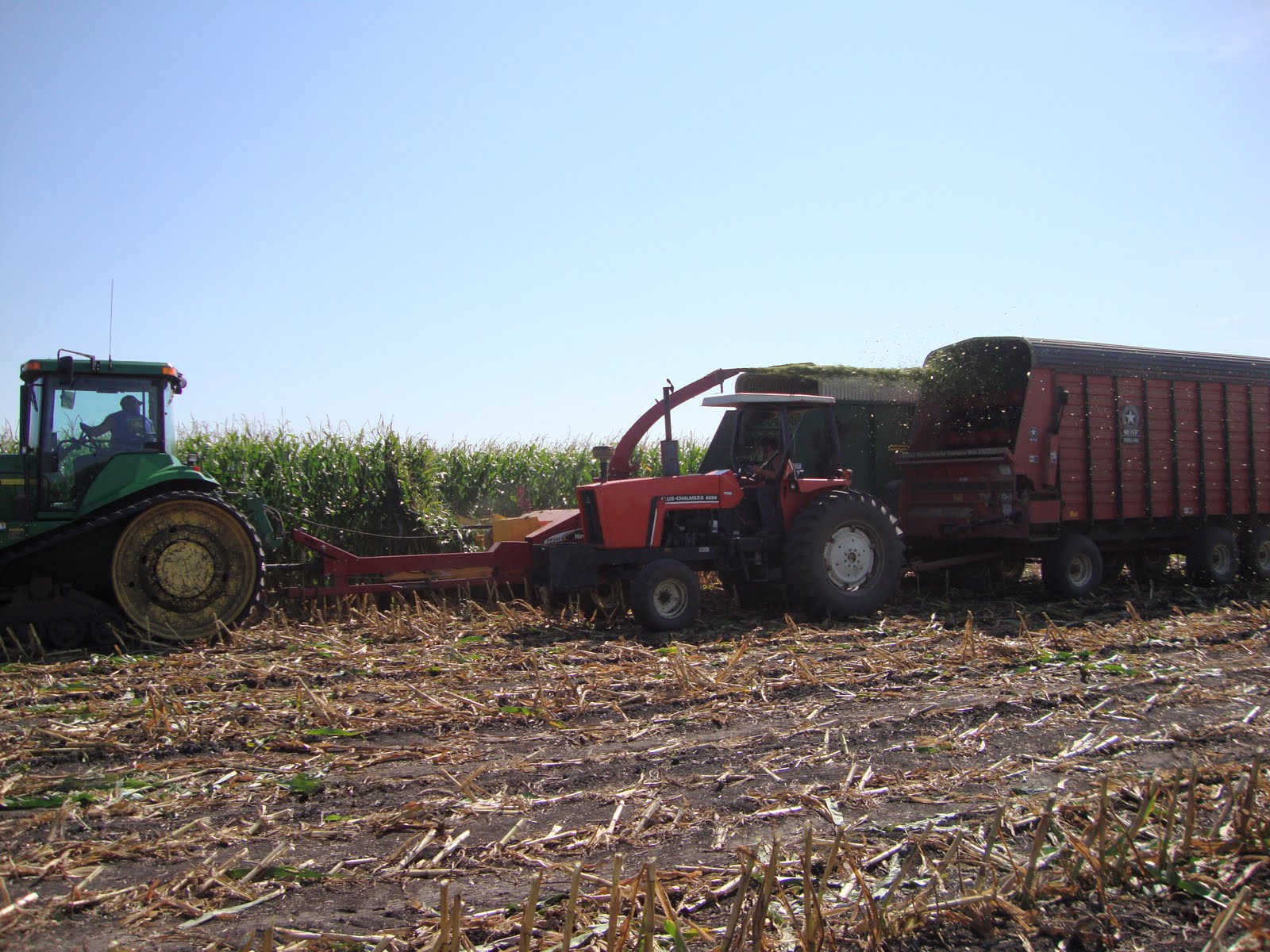
My brother in law and our friend showing off, as they are side winding corn silage into the 2nd silage box so that the chopper doesn't have to stop chopping.

Thanks to the dry and warm weather we had a fair amount of dust on our field roads coming into the farm.

Tall rows of corn, green and full of nutrients for our cows!

Last load of the night! It was a hard one to get in, thanks to some break downs, but we got it done!
Tuesday, August 24, 2010
Corn Silage is Ready!
Today we check our corn to determine if it is ready to be chopped for silage....and it's ready!!!! How do we know that it's ready? Well, I drove out into the field this afternoon and collected samples of corn stalks. In each field I chose 10 stalks of corn and chopped them with the chopper. We collected a sample of the chopped corn, measured it, and dried it with a Koster tester (which removes water from a sample with the use of heated air). After re-measuring the sample we can determine the moisture of the total corn plant. It is ideal to chop corn silage at about 65-69% moisture to be packed into the silage bags. Today's samples told us that the corn is about 64-70% moisture, so it is time to start chopping!!! BUT....we are not ready to chop.
 Last September, we basically destroyed the processor on our chopper. The processor is part of the chopper which crushes corn grain and corn cobs into smaller pieces which are more digestible for cows. By processing our corn we are also able to cut the leaves and stalks into larger pieces which encourages improved rumen health for our cows. This processor is a critical part of our corn silage chopper...and we haven't fixed it since it broke. Today we hit the ground running, making sure that we get the chopper fixed! Jon and his brother Marcus worked long into the evening tonight, putting on the new processor. They are not done yet, but it did rain tonight which buys us about 1 day of additional time to get it ready to rock. We have 9 bags of silage to make this year (each about 250 feet long and 10 feet around). It will be a long task, but with some help from neighbors and family we will get it done as quickly as possible...so the marathon begins!!! Corn silage season is here!!!!

Sunday, January 24, 2010
Busy Days at the Farm
Well it's been a bunch of busy days at the farm lately. Between the birth of 8 calves this week (7 bulls and 1 lonely heifer calf) and a couple of sick cows, oh yeah and the good 'ol Minnesota winter...it's been a busy time!
First the bull calves. We have had 13 bulls out of the last 15 calves born at the farm. The 2 lonely heifers could really use some more friends, so I am hoping that the 2 cows due at the end of this week don't let us down.
Sick cows: nothing that we could really help, but we have 2 cows that have ailments that we and the vet cannot explain. I hate it when we call the vet out and even they can't figure out what is wrong with our sick cows. It's frustrating not knowing what's wrong with a sick animal-they can't tell us where it hurts or how they feel so we have to work smart and watch them. We watch how much they eat, how long they stand to eat, how long do they rest, are they chewing their cuds. We take their temperatures. We listen to their lungs, heart and stomachs. Using these observations we try to decide what might be wrong with our cows. These cows have digestive upsets, basically we have 2 cows that ate something they shouldn't have or they didn't eat as much as they should have. We treat sick cows like this without antibiotics, but instead with probiotics. It is never economical to treat cows with antibiotics-we lose the cost of the drugs as well as the milk lost that we will need to dump until the drugs leave the cow's body. Therefore, we try other methods, that take more time, but in the end are better for the cow and our pocketbook. We have been treating the 2 sick cows with alfalfa meal drench, probiotics, yeast, magnesium, calcium, choline, and other B-vitamins.
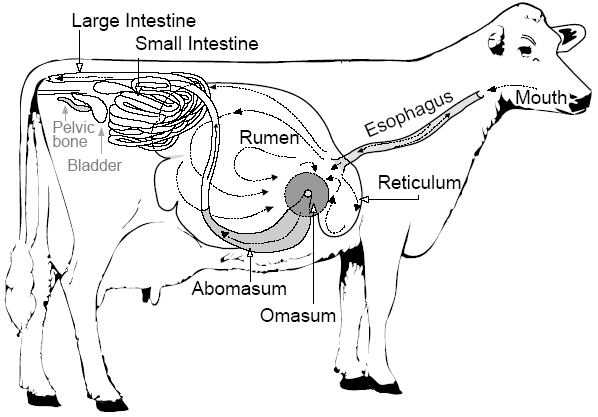
One cow has been responding well to the treatment, however the other decided to roll her stomach....her abomasum. Cows have a 4-chambered stomach, containing the rumen (fermentation chamber), omasum, recticulum (the honeycomb-looking stomach-1st stomach) and abomasum (the true stomach-just like our stomach). When cows have a disruption in their eating pattern, they can fill with gas-which causes their stomach to inflate and float out of place, thereby slowing or even stopping the flow of feed through the stomach. The rumen is a warm, wet environment for some awesome little microbes! They turn food that we as humans can't eat into usable food for cows. When there are problems, the microbes can start dying off, making the cow feel even worse. As a result it is very critical that we keep our cows healthy and eating. Surgery is the only option for a displaced abomasum. After a quick shot of tranquilizer, the vet and I worked for about an hour to relieve the gas in the stomach and stitch it back in place. Within an hour and a half the cow was back to normal, with nothing to show more than her sutures on her side. Needless to say, surgery is expensive and we have to put the cow on penicillin, so we hope to work to make sure a displace abomasum never happens-or that cows don't get sick in the first place.
The MN weather-rain for 12 hours plus 14 inches of snow on the ground=mushy mess everywhere! Slush is everywhere, getting stuck, cows getting wet, lakes forming from puddles, and mainly crummy weather to be outside in....hoping it gets better soon.
First the bull calves. We have had 13 bulls out of the last 15 calves born at the farm. The 2 lonely heifers could really use some more friends, so I am hoping that the 2 cows due at the end of this week don't let us down.
Sick cows: nothing that we could really help, but we have 2 cows that have ailments that we and the vet cannot explain. I hate it when we call the vet out and even they can't figure out what is wrong with our sick cows. It's frustrating not knowing what's wrong with a sick animal-they can't tell us where it hurts or how they feel so we have to work smart and watch them. We watch how much they eat, how long they stand to eat, how long do they rest, are they chewing their cuds. We take their temperatures. We listen to their lungs, heart and stomachs. Using these observations we try to decide what might be wrong with our cows. These cows have digestive upsets, basically we have 2 cows that ate something they shouldn't have or they didn't eat as much as they should have. We treat sick cows like this without antibiotics, but instead with probiotics. It is never economical to treat cows with antibiotics-we lose the cost of the drugs as well as the milk lost that we will need to dump until the drugs leave the cow's body. Therefore, we try other methods, that take more time, but in the end are better for the cow and our pocketbook. We have been treating the 2 sick cows with alfalfa meal drench, probiotics, yeast, magnesium, calcium, choline, and other B-vitamins.
One cow has been responding well to the treatment, however the other decided to roll her stomach....her abomasum. Cows have a 4-chambered stomach, containing the rumen (fermentation chamber), omasum, recticulum (the honeycomb-looking stomach-1st stomach) and abomasum (the true stomach-just like our stomach). When cows have a disruption in their eating pattern, they can fill with gas-which causes their stomach to inflate and float out of place, thereby slowing or even stopping the flow of feed through the stomach. The rumen is a warm, wet environment for some awesome little microbes! They turn food that we as humans can't eat into usable food for cows. When there are problems, the microbes can start dying off, making the cow feel even worse. As a result it is very critical that we keep our cows healthy and eating. Surgery is the only option for a displaced abomasum. After a quick shot of tranquilizer, the vet and I worked for about an hour to relieve the gas in the stomach and stitch it back in place. Within an hour and a half the cow was back to normal, with nothing to show more than her sutures on her side. Needless to say, surgery is expensive and we have to put the cow on penicillin, so we hope to work to make sure a displace abomasum never happens-or that cows don't get sick in the first place.
The MN weather-rain for 12 hours plus 14 inches of snow on the ground=mushy mess everywhere! Slush is everywhere, getting stuck, cows getting wet, lakes forming from puddles, and mainly crummy weather to be outside in....hoping it gets better soon.
Thursday, December 17, 2009
Late Night Ramblings
Here I am, up at 1:54 in the morning, listening to some rock music, working on e-mails. Why you ask would I be working on e-mails at 1 in the morning? Well, the answer is easy...we didn't get home from the farm until Midnight tonight.
It was a good day at the farm, but a long day. We have been working on a cow, Number 20, who has a mystery illness. She gave birth to twins 3 nights ago, and since then she has not been eating as much feed as we hoped that she would. We had the vet look at her yesterday but he couldn't find anything directly wrong with her, so we assume that it is a couple of different things. As a result we "treated" her twice today. She received a "soup" of yeast, vitamins, minerals, and probiotics to help out her rumen-she drank this. And she got a couple liters of IV fluids. She isn't on antibiotics, because she is not sick from an infection but appears to have a digestive upset. Tonight, it was a night and day difference-she was eating everything in sight, so we hope we are over this hurdle.
We delivered 2 new bulls calves today, so we had to tend to the mothers and the boys. All are bedded in and well fed tonight. We also bedded in all of the heifers, dry cows, and milking cows. We had to fill hay feeders in the dry cow lot and the heifer lots. And then at the end of the night we had to head back to the dry cow lot, to look for cows calving-we have 3 that look to be giving birth before sunrise....which brings me to now-this is why I am up....I will be leaving shortly to drive out the farm and check on them. Making sure that in the case that they do calve tonight someone is there to help them and the new calves. I am hoping for no calves until morning-but Mother Nature always wins this argument. So, of to the farm I go, hopefully 3 news calves and 3 happy mothers will greet me =)
It was a good day at the farm, but a long day. We have been working on a cow, Number 20, who has a mystery illness. She gave birth to twins 3 nights ago, and since then she has not been eating as much feed as we hoped that she would. We had the vet look at her yesterday but he couldn't find anything directly wrong with her, so we assume that it is a couple of different things. As a result we "treated" her twice today. She received a "soup" of yeast, vitamins, minerals, and probiotics to help out her rumen-she drank this. And she got a couple liters of IV fluids. She isn't on antibiotics, because she is not sick from an infection but appears to have a digestive upset. Tonight, it was a night and day difference-she was eating everything in sight, so we hope we are over this hurdle.
We delivered 2 new bulls calves today, so we had to tend to the mothers and the boys. All are bedded in and well fed tonight. We also bedded in all of the heifers, dry cows, and milking cows. We had to fill hay feeders in the dry cow lot and the heifer lots. And then at the end of the night we had to head back to the dry cow lot, to look for cows calving-we have 3 that look to be giving birth before sunrise....which brings me to now-this is why I am up....I will be leaving shortly to drive out the farm and check on them. Making sure that in the case that they do calve tonight someone is there to help them and the new calves. I am hoping for no calves until morning-but Mother Nature always wins this argument. So, of to the farm I go, hopefully 3 news calves and 3 happy mothers will greet me =)
Friday, June 19, 2009
Dedication...the word of the day.
Before I get to dedication, I would like everyone to know that Yevette is doing much better today! She was up and alert this morning, ready for her bottle. After drinking 2.5 pints of fresh cow's milk, she napped all day! It was so cute! And she's passing manure too! So we are going to keep her on antibiotics for the next few days. We know we are not out of the woods yet, but she's giving us positive signs!
We also started weaning Joey today. Weaning means that we are gradually allowing Joey to eat more dry feed and water instead of being dependent on milk for her food source. We start weaning by providing water in the morning instead of milk, and feed milk only at night for about 5-7 days. We closely monitor how well the calves adjust to water, and when they are ready we transition them to water for both feedings. So far Joey is taking to weaning just fine! She's eating lots of dry feed as well. We switch calves to water at about 45-60 days old. We do this for a couple of reasons: cost, convenience, and the most important reason: dry feed and water help to stimulate and rumen development. Dry grain and water stimulates the papillae in the rumen to grow and develop, therefore growing into a very healthy and efficient stomach to digest forages in the future. Milk is digested in the abomasum, therefore it does not help to develop the rumen. Anything we can do to make healthy future cows!
As for dedication...Dairy farmers are dedicated, more than most consumers would ever know. This week we celebrated our 4th Wedding Anniversary. Most married couples would have went out to for drinks, a romantic dinner, and a stroll by starlight, but not us. Don't get me wrong, we did have plans, plans for dinner and drinks anyways. BUT...the cows had other ideas. We worked hard all day. Even though we could take ALL day off for our anniversary we thought we would take the evening off after milking. We hurried through the tasks for the day and started our chores early in the evening. As hard as we worked to get ahead, the "farm" pushed us back twice as hard. It's frustrating some days, but dairy farmers often learn to deal with it. Dairy farmers' wives have a harder time dealing with it, including me. Even though I understand, it still doesn't change the fact that I am a woman and I like to have my special nights ;)
Nevertheless, we had 2 baby calves born that day. The sprinkler system for the cows was broke and needed to be fixed ASAP. One of the pulsators in the milking parlor was not working, so it needed to be fixed. AND because the weather was so hot and humid we needed to water the cattle and calves multiple times. After all of that it was too late to go on our date. Instead we finished up, headed home after 10pm, had a small supper, and went to bed-romantic huh?
When I was working at the local cooperative I worked with many dairy farmers. Some who had enough cows that they could afford to hire labor to handle the farm so they could go out with their families and wives. Others, who did not have enough cows to afford hiring labor, but still found a way by being flexible. Some dairy farmers have not ever gone on a vacations and others only leave the farm to go to town for parts and Sunday church-and they were proud of this! Dedication. Dedicated to their cows, not because it makes them money, but because they genuinely want the best for their cows. They don't walk away when a cow is calving or sick to be with their families, but tend to their cows first. Vacations take a back seat to making high quality feeds to make healthy cows and quality milk. Often dairy farmers make sacrafices, most of which go unknown to the consumer. So here's to you, Dairy Farmer! For your deidcation, putting your animals first, supporting your family and caring for your farm. You should be in the Webster next to the definition.
Dedication.
We also started weaning Joey today. Weaning means that we are gradually allowing Joey to eat more dry feed and water instead of being dependent on milk for her food source. We start weaning by providing water in the morning instead of milk, and feed milk only at night for about 5-7 days. We closely monitor how well the calves adjust to water, and when they are ready we transition them to water for both feedings. So far Joey is taking to weaning just fine! She's eating lots of dry feed as well. We switch calves to water at about 45-60 days old. We do this for a couple of reasons: cost, convenience, and the most important reason: dry feed and water help to stimulate and rumen development. Dry grain and water stimulates the papillae in the rumen to grow and develop, therefore growing into a very healthy and efficient stomach to digest forages in the future. Milk is digested in the abomasum, therefore it does not help to develop the rumen. Anything we can do to make healthy future cows!
As for dedication...Dairy farmers are dedicated, more than most consumers would ever know. This week we celebrated our 4th Wedding Anniversary. Most married couples would have went out to for drinks, a romantic dinner, and a stroll by starlight, but not us. Don't get me wrong, we did have plans, plans for dinner and drinks anyways. BUT...the cows had other ideas. We worked hard all day. Even though we could take ALL day off for our anniversary we thought we would take the evening off after milking. We hurried through the tasks for the day and started our chores early in the evening. As hard as we worked to get ahead, the "farm" pushed us back twice as hard. It's frustrating some days, but dairy farmers often learn to deal with it. Dairy farmers' wives have a harder time dealing with it, including me. Even though I understand, it still doesn't change the fact that I am a woman and I like to have my special nights ;)
Nevertheless, we had 2 baby calves born that day. The sprinkler system for the cows was broke and needed to be fixed ASAP. One of the pulsators in the milking parlor was not working, so it needed to be fixed. AND because the weather was so hot and humid we needed to water the cattle and calves multiple times. After all of that it was too late to go on our date. Instead we finished up, headed home after 10pm, had a small supper, and went to bed-romantic huh?
When I was working at the local cooperative I worked with many dairy farmers. Some who had enough cows that they could afford to hire labor to handle the farm so they could go out with their families and wives. Others, who did not have enough cows to afford hiring labor, but still found a way by being flexible. Some dairy farmers have not ever gone on a vacations and others only leave the farm to go to town for parts and Sunday church-and they were proud of this! Dedication. Dedicated to their cows, not because it makes them money, but because they genuinely want the best for their cows. They don't walk away when a cow is calving or sick to be with their families, but tend to their cows first. Vacations take a back seat to making high quality feeds to make healthy cows and quality milk. Often dairy farmers make sacrafices, most of which go unknown to the consumer. So here's to you, Dairy Farmer! For your deidcation, putting your animals first, supporting your family and caring for your farm. You should be in the Webster next to the definition.
Dedication.
Subscribe to:
Posts (Atom)