Showing posts with label sick cows. Show all posts

Wednesday, April 29, 2015

Using Your God Given Talents

This past weekend I had the privilege of milking cows and helping do chores for my brother while he went on a short weekend trip with his wife.  I had the opportunity to help my dad take care of their 120 cows, and it was a great weekend!  My brother was in the process of working on 4 cows before he left, to help them feel better.  On Friday night my dad was a little stressed over the thought of caring for these cows without my brother there, “never fear, I am here!” 

Saturday morning, after morning milking and chores, I dusted off my cow care and diagnostic skills and went to work.  Each cow got a thorough check up.  I used a stethoscope to check heart rate, respiration rate, and rumen movement (if their stomachs were moving).  I used a thermometer to check their temperatures, making sure we didn’t have cows with fevers.  I also sleeved up and palpated the cows that had just had baby calves, ladies you know what this is all about if you’ve ever been to the gynecologist.  2 of the 4 cows were doing just fine, the other 2 were doing only ok, but were going to need a little more work.  We don't accept anything less than excellent health for our cows.
Close up shot of my thermometer, this is the cow with a low grade fever (average temperature of a cow is about 101.5) yes we check temperatures rectally.
 
Felfie of me checking for rumen movement with my stethoscope.

After having a good look at their medical histories (yes, dairy farmers keep detailed records on their cows’ medical histories!) we came up with a plan of action for treatment.  One cow was treated with antibiotics because she had a low grade fever (sign of an infections) and her milk was discarded for the following milkings.  The other cow was not treated with antibiotics, but with probiotics, vitamins, and a little boost of sugar.  By Sunday night those 2 cows were doing so well.  There is nothing more gratifying that using my God given gifts and talents to treat and care for God’s precious creatures.  I take animal care very seriously, and believe they always deserve our very best.  Having the gifts and skills that I have from God, makes it even more important for me to put animal care first....not everyone can be a dairy farmer or dairy farmHer ;)  Prevention is always key on a dairy farm, but when we make sick animals feel better…the feeling of joy and pride is priceless J 

Wednesday, May 18, 2011

Wordless Wednesday: Antibiotic Tests

Did you know dairy farms test for antibiotics on farm? Shown here are 2 samples from 2 cows in our herd.  The yellow sample is a cow that is negative for antibiotics, and will return to the milking herd, producing milk for consumers.  The purple sample is a cow that tested positive for antibiotics and will NOT return to the milking herd.  She will remain in the sick cow pen, where her milk is dumped and NEVER used for human consumption!  Milk is tested 17 times before it reaches the consumers!

Tuesday, April 27, 2010

Do cows get the "flu"?

As I type this I am dealing with the "crud" that's been going around thanks to our dramatic weather changes in MN.  It's been 70's for a week and now, today, it's 50's and rain...which means "crud" for my throat.  It got me thinking about a question that I was once asked...."Do cows get the flu?"

About 2 weeks ago, when Jon was gone for his grandfather's funeral, I was left home alone with the cows.  While doing morning chores, I noticed something was terribly wrong with my girls...most of them had the diarrhea!  I immediately went into detective mode.  What was causing my cows to be sick?!?!?!  After taking the temperatures of a couple of them I determined that they had contracted the "cow flu", known to dairy farmers as dysentery.  Dysentery is contagious, so once a couple cows get it, a few more will follow until the whole herd has had it...just like the flu in humans! I have never seen a cow with a vomitting flu, but just diarrhea.  

So does this affect milk quality?  Absolutely not, the milk is still safe for humans!  Unlike some other pathogens, when a cow gets dysentery, she lowers her milk production until she feels better, but she never produces milk of poorer quality, and humans definitely don't get dysentery from cows, otherwise Jon and I should have had it more than a couple of times.  Needless to say we have both experiences the messes of cows with diarrhea on our clothes and in our faces.  It's a virus known only in cows, carried by birds (which we have) or transfer by people moving from farm to farm.

Just like people, its been a couple of years since we had dysentery so the cows got it bad.  So what happens to cows when they have to flu? How do you treat it??? Cows lower their milk production so that their bodies can focus on getting better.  They work on lowering their fevers, feeling better, resting, eating, and increaing milk production back to previous levels.  Sometimes later lactation cows (cows that have been milking over 200 days) have a hard time gaining back lost milk production since they are also later gestation (only a couple months from having another calf).  These later lactation cows will focus on their calf instead of milk, and that's just fine with us.  We want them happy and healthy.  If we didn't treat the cows, they would actually get better all on their own.  It takes a couple of days, but most cows will recover without a problem and without intervention.  However, I care for my cows and decided that we were going to spend some money on a treatment.  Since this is a digestive infection, we opted for probiotics (bacteria which help to keep the cow's stomach healthy).  Probiotics are natural and readily available.  I chose  a combination of natural yeasts and lactobacillus bacteria.  These worked to keep my cows eating until they recovered.  I mixed them into their TMR (feed) making sure that each cows had a taste of the "good bugs".  Other than adding "good bugs" to the feed for 10 days, we just watched the cows making sure those that got sick were still eating and getting better. 

A couple of fresh cows got the "flu" worse than the other cows...just like how some people get the flu worse than others.  We treated these with electrolytes (just like Gatorade) to help replenish their fluids and IV fluids if we needed to act quickly.  Since these cows just had calves they were more susceptible to the symptoms of dysentery; their immune systems where not as active as the milking cows. 

When did the cows recover?  I can honesly say that our cows took exactly 2 weeks to recover completely.  It took 14 days for the dysentery to go through the entire herd, a couple cows each day.  But as of today the herd is milking at the same level that they were before they got sick, about 90 pounds per cow per day.  We lost on average, about 10 pounds of milk per cow during the worst of it.  This means each day we lost about $160 income, or $2240 total, in the past 14 days.  We don't focus on the lost income as much as the success of getting everyone through the "flu" with everyone still alive and kickin'!  We are hoping that the girls are exposed to it now and should have immune systems set up to handle the "flu" the next time it comes around.

Moral of the StoryFarmers care for their cows every day, their health is our number one priority!! 

Sunday, January 24, 2010

Busy Days at the Farm

Well it's been a bunch of busy days at the farm lately. Between the birth of 8 calves this week (7 bulls and 1 lonely heifer calf) and a couple of sick cows, oh yeah and the good 'ol Minnesota winter...it's been a busy time!

First the bull calves. We have had 13 bulls out of the last 15 calves born at the farm. The 2 lonely heifers could really use some more friends, so I am hoping that the 2 cows due at the end of this week don't let us down.

Sick cows: nothing that we could really help, but we have 2 cows that have ailments that we and the vet cannot explain. I hate it when we call the vet out and even they can't figure out what is wrong with our sick cows. It's frustrating not knowing what's wrong with a sick animal-they can't tell us where it hurts or how they feel so we have to work smart and watch them. We watch how much they eat, how long they stand to eat, how long do they rest, are they chewing their cuds. We take their temperatures. We listen to their lungs, heart and stomachs. Using these observations we try to decide what might be wrong with our cows. These cows have digestive upsets, basically we have 2 cows that ate something they shouldn't have or they didn't eat as much as they should have. We treat sick cows like this without antibiotics, but instead with probiotics. It is never economical to treat cows with antibiotics-we lose the cost of the drugs as well as the milk lost that we will need to dump until the drugs leave the cow's body. Therefore, we try other methods, that take more time, but in the end are better for the cow and our pocketbook. We have been treating the 2 sick cows with alfalfa meal drench, probiotics, yeast, magnesium, calcium, choline, and other B-vitamins.

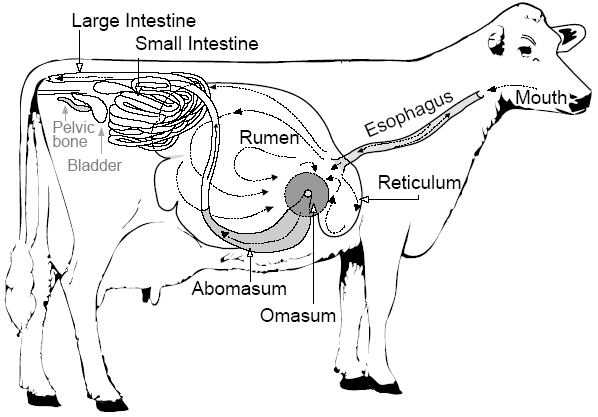
One cow has been responding well to the treatment, however the other decided to roll her stomach....her abomasum. Cows have a 4-chambered stomach, containing the rumen (fermentation chamber), omasum, recticulum (the honeycomb-looking stomach-1st stomach) and abomasum (the true stomach-just like our stomach). When cows have a disruption in their eating pattern, they can fill with gas-which causes their stomach to inflate and float out of place, thereby slowing or even stopping the flow of feed through the stomach. The rumen is a warm, wet environment for some awesome little microbes! They turn food that we as humans can't eat into usable food for cows. When there are problems, the microbes can start dying off, making the cow feel even worse. As a result it is very critical that we keep our cows healthy and eating. Surgery is the only option for a displaced abomasum. After a quick shot of tranquilizer, the vet and I worked for about an hour to relieve the gas in the stomach and stitch it back in place. Within an hour and a half the cow was back to normal, with nothing to show more than her sutures on her side. Needless to say, surgery is expensive and we have to put the cow on penicillin, so we hope to work to make sure a displace abomasum never happens-or that cows don't get sick in the first place.

The MN weather-rain for 12 hours plus 14 inches of snow on the ground=mushy mess everywhere! Slush is everywhere, getting stuck, cows getting wet, lakes forming from puddles, and mainly crummy weather to be outside in....hoping it gets better soon.

Saturday, October 10, 2009

The joys of dairy farming!

Today was one of those days, where you REALLY have to LOVE your job. It was a day where you really have to ENJOY the JOYS OF DAIRY FARMING....

This morning we dried off 5 cows (time for them to go on a 2 month vacation before they have their next calf). After that we noticed a cow that we gave medication to induce labor had finally started labor. After carefully observing her for a couple hours we decided to intervene, but not before we chased the cow out of the mud holes in the dry cow yard twice. We helped pull the calf, a bull calf, and momma cow was doing so well! After taking care of calf and cow, we moved on to a cow that had gotten herself stuck in the mud. Well, actually she was playing with another cow and it got a little rough. #55 fell down into a thick muddy hole, and couldn't get back out. We rushed to her rescue, using the skid loader to move the mud out the way and lift her out of the mud. Success! #55 was out of the mud, but she was also in shock. SO....we gave her some calcium for muscle tone, dextrose (sugar) for some quick energy, and some pain medication in case she hurt her leg....but one that was safe for her and the calf that she is carrying. We finished that up and got to chase a heifer that needed to be bred through another mud hole in the heifer yard! Seems like all of the cows were looking for those darn mud holes today! We got Lucy into the barn for breeding. We use artificial insemination for breeding, because it is safer for cows and people to NOT use a bull. Plus we get to use genetics from around the world on our farm to improve our cows. We bred Lucy.....next, move fresh cow (cow that calved) to the milking barn....and of course she found the mud on the way to the barn.....yikes! Next we found another cow in the dry cow yard that had an infection in her foot....she got a cut and thanks to all of the mud, she now had an infection....so we moved her to the barn to get a shot of Penicillin.

Sure sounds like we were treating a lot of cows, but we were merely working around the environment that Mother Nature provided us this week. 4.5 inches of rain and cool/cold weather makes for some muddy conditions outside. Cows are unfortunately not smart enough to stay out of said mud, therefore we tend to have cows that get into trouble. We are definitely looking forward to the day that we can put all of the cows inside a barn during the muddy seasons! Once we have the money you can bet that we will be putting up a barn ASAP! In the meantime we are working to keep the cows as dry as possible...

Oh yeah did I mention that Minnesota Winter is here! It's snowing outside as I type this! I can't believe it! 6 months of winter in this darn state! I am beginning to question Global Warming especially since I remember when it was 70 degrees in November just a few short years ago. Oh well, dealing with the cards we are dealt, and enjoying the JOYS OF DAIRY FARMING!

Saturday, September 5, 2009

The Case of the Moldy Hay

As mentioned in some earlier posts we struggled with some issues with sick cows and heifers. We had some cows ill with toxic mastitis and we had a heifer die tragically from a hemorrhage in her intestines all within the same week. As dairy farmers often have to work as investigators, searching to solve a problem for the good of our animals. We have had experiences such as this over the last few years and we have learned from each of these experiences. With the pack barn that we run we allow the cows to sleep on bedding mixed with manure solids-it's clean dry and comfortable, better than the pasture-think Tempurpedic mattresses. As the manure break downs bacteria move in. As long as the cows are healthy and their immune systems are running at full force, the bacteria is harmless....BUT if the cows are under ANY stress these bacteria can now become harmful.

And that's where the investigation starts. Jonathan and I knew immediately that these 3 sick cows meant that something was wrong, and we knew that the only thing that we changed in the past week was the new alfalfa hay that we purchased to feed the cows and heifers. We remembered that in the past we had hay that had mold in it and made the cows sick, very sick, and we caught the mold when it was too late. I am glad to report that we learned from our previous mistakes and immediately stopped feeding that purchased hay to the cows and found some different hay from a neighbor to feed. Almost immediately the cows that were sick got better and the Somatic Cell Count that was rising, came down. These signs told us that it was in fact the hay, so we had it tested for mold. Our local feed representative came out to the farm and pulled cores from the bales and sent them to a lab for testing. After culturing the hay samples for mold we received the results that we expected....the hay was positive for mold, a mold that is very dangerous for cows....Aspergillus. Aspergillus is known to produce a mycotoxin that hinders immune systems, causes internal hemorrhaging, and other bad things.

So you ask yourself, how did the hay get moldy? Well, it's quite easy, alfalfa is cut, dried and baled, but this pile of hay was cut and not allowed to dry to a low enough moisture level to be baled. It was baled, which compressed the wet alfalfa next to each other and allowed an environment perfect for mold to grow. The mold is very small, almost unseen to the human eye, but we did notice it's signature white fuzz on a couple bales after the fact. Thankfully we removed the hay from the cows diets before it could make more of them sick. The importance of HIGH QUALITY feed for cows cannot be stressed enough. The better quality the feed for cows, the better the cows' overall health and production. We work tirelessly to make high quality haylage and corn silage for our cows at Orange Patch Dairy, and we try to buy clean dry hay. The hay grower that we purchased this hay from was not aware that his hay was moldy-and frankly it did look very green and dry, inside the bales it was a different story. After calling our grower, he will move the hay back home to be destroyed and he will refund us the money that we paid.

As a result the cows at Orange Patch Dairy are doing MUCH better, happy healthy, and producing!!!! Yet another example of how dairy farmers continue to look out for the best for their cows....Happy cows are producing cows!